The Intuit Enterprise Suite Summer Release goes live on August 12, 2026. Every feature in this rollout is now available directly in product. This release adds real depth in two areas. It changes how you report on your business, and how fast you can close the books across entities. That matters for businesses running multiple entities, tracking project profitability, or managing inventory across locations. It also introduces smaller updates across multi-entity operations, projects, inventory, AI, business intelligence, single sign-on, and workforce management. For background on the platform, see what Intuit Enterprise Suite is and who it is built for and Intuit’s own product overview.
Release Highlight: Reporting That Finally Matches How Your Business Runs
Every business is more than a single bottom line. Regions, departments, product lines, and cost centers sit underneath the totals. Each one tells a different part of the story. Intuit Enterprise Suite has offered classes for this kind of tracking, but classes cap out at one attribute per transaction line. Dimensions remove that ceiling.
More attributes, fewer workarounds
With this release, businesses can tag a single transaction with up to 20 attributes instead of one. Dimensions now work everywhere classes do, across both reports and transactions. Several additions close long-standing gaps. Dimensions now apply to Time entries, billable expenses, and recurring payment transactions. Users can also assign a dimension at the header level of an invoice instead of line by line. A new Balance Sheet by Dimensions report is rolling out in beta for single-entity companies. Project-based businesses gain eight additional dimension-based reports, including cost to complete and work in progress. Reparenting dimensions is also now supported, so reporting structures can evolve as a business grows.
Why it matters for reporting
For a construction or professional services company running multiple divisions, this means real answers fast. A question like “what is our margin in the Southwest for commercial accounts” becomes a single report. No exporting to Excel. No rebuilding a pivot table every month. Dimensions also feed directly into budgeting and forecasting. Teams can set targets and track variance at whatever level of detail actually matches the business. Getting the most out of dimensions usually comes down to setup and adoption. That is why OOTB built dedicated Intuit Enterprise Suite training around exactly this feature.
Release Highlight: Closing Faster Across Every Entity
Multi-entity businesses know the intercompany close eats time every single period. Last spring, Intuit Enterprise Suite moved intercompany eliminations from a reporting-time exercise into a real-time, transaction-level calculation. This release builds directly on that foundation.
Smart automation for intercompany entries
Intercompany Journal Entry Smart Complete now detects the transaction type based on the lines a user enters. It automatically generates the required due-to and due-from entries, intercompany contacts, and partner company assignments. The user supplies the business intent, and the platform handles the accounting structure underneath it. Recurring templates are now generally available, letting teams turn repeating intercompany journal entries and dynamic allocations into templates. Those templates run automatically each period instead of being rebuilt by hand.
Auto-posting rounds out the automation. Businesses can define a mapping that ties a selling company, a product or service, and a buying company to a specific category. When that mapping is active, matching bills skip manual review. They post automatically.
The impact on close time
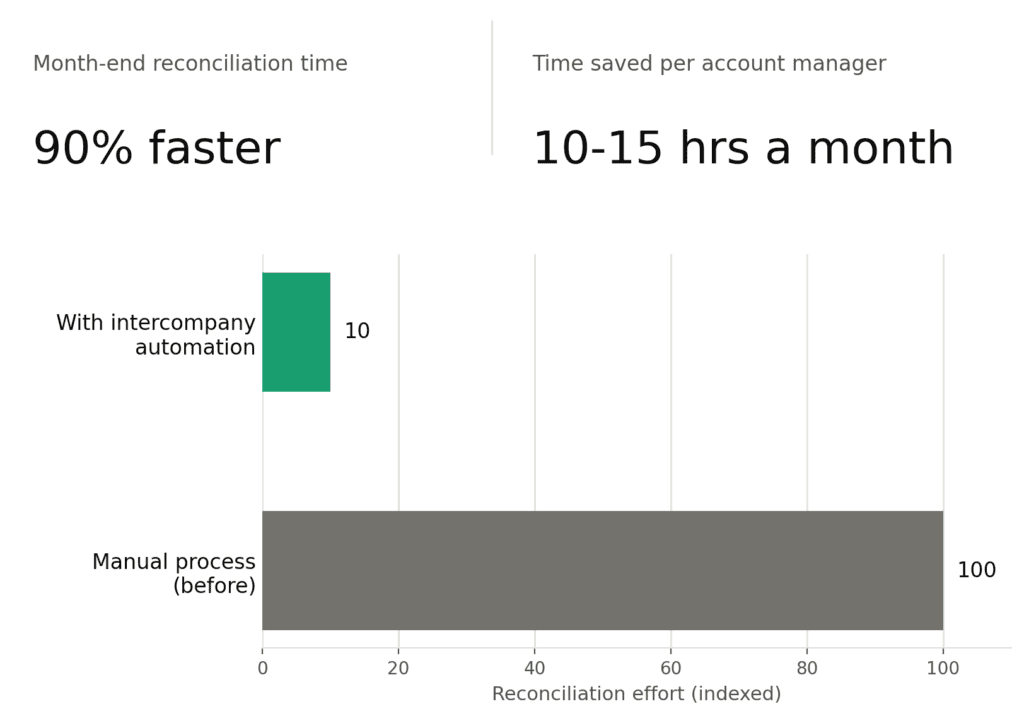
Customers piloting these tools have reported meaningful time savings. One account management team estimated 10 to 15 hours saved per manager each month. Another cited a 90 percent drop in month-end intercompany reconciliation time during peak season. As with existing intercompany eliminations, the platform surfaces recommendations rather than acting unilaterally. Automation only runs where a business has explicitly turned it on. This kind of automation matters most for businesses consolidating multiple QuickBooks files into a single Intuit Enterprise Suite instance. Intercompany transactions there were previously tracked by hand.
More Updates Across Intuit Enterprise Suite
Multi-entity
Multi-entity operations pick up Cross-Company Bill Payment. It lets a business record a bill payment in one entity using a bank account that belongs to another. The intercompany accounting is handled automatically. Multi-level entity hierarchies, introduced last spring for consolidated reporting, now extend into KPIs and dashboards as a beta feature. Multi-currency management is also getting a significant upgrade in beta. Exchange rates are now managed in a single protected table. Businesses get clearer visibility into how rate changes affect transactions, plus automatic unrealized gain and loss calculations. That multi-currency beta is currently limited to organizations with a U.S. dollar functional currency, with support for international currencies expected this fall. These additions build on the multi-entity hub and hierarchy work from the Intuit Enterprise Suite Spring 2026 release, continuing a pattern of quarterly investment in cross-entity operations.
Projects
Project-based businesses gain two new reports: Open Purchase Orders by Project and Project Costs by Vendor. Users can also apply dimension filtering directly on project reports. Ship-to addresses on purchase orders now default automatically to a project’s site address, and payroll can be split across projects. A beta feature for project-specific user permissions will let businesses restrict project manager access to only their assigned projects. AI suggests assignments where a company has multiple managers and projects in play.
Inventory
Units of Measure let businesses order, receive, and sell the same item in different quantities, such as the case, the pack, or the individual unit. No more forcing every transaction into a single measurement. Invoices now also support multiple shipping addresses per customer. Users can select from a saved list instead of retyping an address each time a customer orders to a different location.
AI
Intuit Intelligence is expanding with a new natural-language chat interface in beta. Users can ask questions and generate insights across entities without building a custom report first. Chart of Accounts standardization now supports applying a standard structure to a subset of entities rather than the whole organization. Businesses migrating from QuickBooks Online or QuickBooks Desktop also gain a beta tool. It suggests how to reclassify existing Locations or Custom Fields into dimensions, based on prior transaction history.
Business Intelligence
Business Intelligence tools are also getting sharper. The KPI scorecard now supports Class and Dimension filters, along with drill-down access into any individual metric. Management reports in the consolidated view can generate AI-written executive summaries. They also include smart chips that update automatically as underlying data changes. Multi-level grouping now supports up to six nested dimensions with drag-and-drop reordering. Two beta features, multi-dimension Display By reports and multi-dimensional pivots, allow deeper cross-tabulation directly in the platform, with no need to export to a spreadsheet.
Single sign-on
Single sign-on support now allows businesses to provision and manage Intuit Enterprise Suite access through Google, Okta, or EntraID. Access is revoked automatically the moment an employee leaves the company.
Workforce Solutions
Workforce Solutions adds dimension integration with Time and Payroll in beta. Payroll admins can split paychecks across dimension values. A beta custom report builder for Payroll is also included.
What This Means If You Are Evaluating Intuit Enterprise Suite
Many of the features in this release are rolling out through Intuit’s Early Access Program between August and October before reaching general availability, so the experience will keep evolving through the fall. For businesses currently running QuickBooks Desktop or QuickBooks Online and outgrowing what those platforms can report on, or for multi-entity organizations still closing the books manually across subsidiaries, this release is a good moment to take a closer look at what Intuit Enterprise Suite can now do. For a fuller record of how the platform has progressed release over release, Intuit’s own Spring 2026 Intuit Enterprise Suite release notes are worth a read alongside this summer update.
How We Can Help
As an Intuit Enterprise Suite implementation partner, Out of the Box Technology helps businesses evaluate whether IES is the right fit, plan a migration path, and configure dimensions, intercompany automation, and reporting to match how the business actually operates. Our Intuit Enterprise Suite implementation guide walks through what that process looks like end to end.
If your team is weighing a move to Intuit Enterprise Suite or wants help putting these new features to work, reach out to the OOTB team to talk through next steps.
Related reading:
- Intuit Enterprise Suite Implementation Partner
- Step-by-Step Guide to Preparing for an Intuit Enterprise Suite Migration
- Chart of Accounts Migration to Intuit Enterprise Suite: A Controller’s Guide
- Migrating QuickBooks Online Advanced to Intuit Enterprise Suite
- 7 Critical Financial Reports to Run Before You Close the Fiscal Year