Intuit does not publish a list price for Intuit Enterprise Suite. Every quote is built around your entity count, user count, and the capabilities you turn on, which means you cannot answer the worth-it question from a pricing page the way you can with QuickBooks Online.
That makes the evaluation harder than it needs to be. Finance leaders end up comparing a custom quote against a number they already know, which is usually their current subscription. The new figure looks large next to the old one. But the comparison is incomplete, because it weighs the full cost of the new system against only the visible cost of the current one. The hours your team spends bridging the gaps in your existing setup never appear on an invoice, so they rarely appear in the business case either.
This piece lays out what Intuit Enterprise Suite tends to cost, what belongs on both sides of a real total cost of ownership calculation, and what the available Intuit Enterprise Suite ROI research actually says.
What Intuit Enterprise Suite Costs
Pricing is contract-based and sold through Intuit’s sales organization, so there is no published rate card to work from. What you can plan around is the shape of the quote rather than the figure. It scales with the number of entities you consolidate and the number of users who need access. It also scales with the capabilities you switch on, including payroll, project management, and the deeper reporting tools.
What that means in practice is a product positioned well above QuickBooks Online Advanced and well below a traditional mid-market ERP. Intuit’s own Intuit Enterprise Suite pricing page directs buyers to a tailored consultation. The only reliable number is the one on your quote. Third-party estimates circulate freely, and the spread between them is wide enough that planning against one is a mistake.
The Comparison That Changes the Answer
Most businesses evaluating Intuit Enterprise Suite are weighing it against one of two things. Either they are looking up from QuickBooks Online Advanced, or they are looking down from a traditional ERP quote. Both comparisons shifted in 2026.
QuickBooks Online Advanced has increased in price several times over the past two years, with the steepest of those increases landing in 2026. That price applies per company file. A group running three entities on Advanced pays it three times over. That group still has no consolidation, no intercompany automation, and one reporting dimension. Add the tools bridging those gaps and the totals move closer together than most finance leaders expect. In some configurations they converge, which changes the Intuit Enterprise Suite ROI question from whether you can afford the move to what you are already paying for the workarounds.
The view from the other direction has always favored Intuit. NetSuite, Sage Intacct, and Dynamics 365 Business Central deliver comparable multi-entity capability at a materially higher annual cost. Their implementation timelines are measured in quarters rather than weeks. Pull current figures for whichever products sit on your shortlist, because pricing across this category has moved repeatedly and any number older than a quarter is unreliable.
The Cost Side Most Quotes Leave Out
A subscription figure is not a total cost of ownership. The number that belongs in your model includes the work required to make the system produce the reports you need.
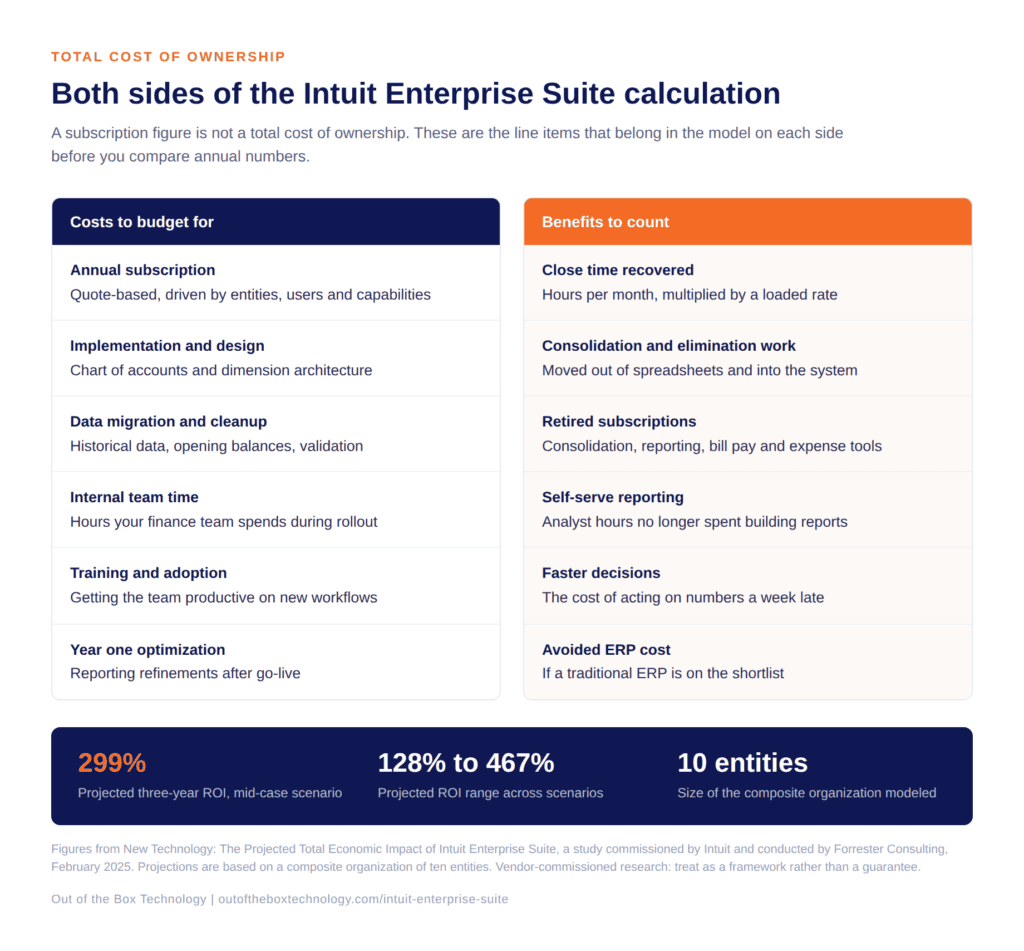 On the cost side, budget for implementation and system design, data migration and cleanup, and internal team time during the rollout. Add training and whatever ongoing optimization you expect in year one. Design work is the line item most often underestimated. Your chart of accounts and dimension architecture determine whether the reporting still works in five years, or whether it needs rebuilding in eighteen months.
The credit side of the same ledger gets forgotten just as often. Many groups arrive at Intuit Enterprise Suite carrying a consolidation tool, a separate reporting or dashboard subscription, a bill pay platform, an expense tool, and a payroll add-on. Several of those become redundant. Subtract them before you compare annual figures. The fair comparison is against your whole finance technology stack rather than against your accounting subscription alone.
There is one more line worth adding, and it is the least comfortable one. If your close currently depends on a spreadsheet that only one person understands, that dependency is a cost. It shows up as key person risk, as audit friction, and eventually as a rebuild when that person changes roles.
What the Intuit Enterprise Suite ROI Data Shows
Forrester Consulting produced a projected Total Economic Impact study on Intuit Enterprise Suite, commissioned by Intuit in February 2025. Vendor-commissioned research deserves appropriate skepticism, and the value here is the framework rather than the headline.
The study modeled a composite parent company made up of ten entities across North America. It projected a 299% return on investment over three years in the mid-case scenario. The reported range across scenarios ran from 128% to 467%. That spread is wide, which is the point. Intuit Enterprise Suite ROI depends heavily on how much manual work your current setup requires. A business with a clean close will land toward the bottom of that range. Forrester published a second study focused on accounting firms in September 2025.
What matters for your own model is where those benefits came from. Consolidation work moved out of spreadsheets and into the system. Close cycles shortened, which shortened the delay between an operational problem occurring and leadership seeing it. Redundant technology subscriptions came off the books. Reporting that previously required an analyst became self-serve.
Turning That Into Your Own Number
Start with hours. Count the days your team spends on consolidation, eliminations, intercompany reconciliation, and report building each month, then apply a loaded hourly rate. Multiply by twelve. That figure alone often covers a meaningful share of the annual subscription.
Next, count the subscriptions you would retire and add their annual cost to the benefit side. Then estimate the cost of decisions made late because the numbers arrived late. That one is harder to quantify, and it is usually the largest item on the list. Finally, if a traditional ERP sits on your shortlist, the avoided implementation cost belongs in the model as well.
One caution on the exercise. Build the model on your current volumes rather than your projected ones. A business case that only works at next year’s revenue is a forecast rather than a justification, and it tends to fall apart at the first quarter that misses plan.
When the Answer Is No
Some businesses should stay where they are. Picture a company with one entity, one reporting dimension, fewer than twenty-five users, and a three-day close that requires no spreadsheet gymnastics. QuickBooks Online Advanced is doing its job there, and the return on a move would be thin.
Timing matters too. A group in the middle of an acquisition, a system consolidation, or a finance leadership change has limited capacity for a platform project. The return does not disappear in those situations, but it arrives later than the model suggests, and the implementation carries more risk.
The same applies if your complexity sits in manufacturing or warehouse operations. Intuit Enterprise Suite does not carry deep manufacturing or warehouse management functionality. A business whose main constraint lives there will get better value from a platform built for that work, and the Intuit Enterprise Suite ROI case will be hard to make.
The Question Worth Asking Your Team
Ask your controller how many hours the last close consumed, and how many of those hours produced a number that a system could have produced instead. That figure, multiplied across a year, is the real comparison point for any Intuit Enterprise Suite ROI calculation.
How We Can Help
Want that number for your business? Out of the Box builds the cost and benefit picture with you before anyone talks about implementation, including the honest version where staying put is the right call. Our guide to choosing an Intuit Enterprise Suite implementation partner covers what the work involves once the numbers make sense.
If your team is weighing a move to Intuit Enterprise Suite or wants help putting these new features to work, reach out to the OOTB team to talk through next steps.
Related reading:
- What Is Intuit Enterprise Suite? A Guide for Growing Businesses
- Intuit Enterprise Suite Multi-Entity Accounting Explained
- QuickBooks Desktop to Intuit Enterprise Suite Migration: A Complete Walkthrough
- Streamlining Multi-Entity Accounting with Intuit Enterprise Suite