Most businesses meet Intuit Enterprise Suite for the first time as a step up from QuickBooks Online Advanced. More users, better reporting, the same familiar interface. That introduction is accurate as far as it goes, and it undersells the product badly.
Intuit built this platform for groups. A single login can manage more than 200 entities. Intercompany entries post to both sides automatically, and eliminations run at the transaction level. Consolidated financial statements then assemble in real time, rather than in a workbook somebody maintains by hand. Dimensional reporting runs across the whole group, so you can see performance by region or service line without asking each company for its own version of the answer.
Many groups still think of Intuit Enterprise Suite as a bigger version of QuickBooks. If yours is one of them, the gap between what you are using and what is available is probably measured in days of close time every month.
Where the Single Entity Assumption Comes From
The assumption is a lineage problem. Intuit Enterprise Suite sits on a QuickBooks foundation, and QuickBooks has spent three decades being the small business answer. Finance leaders see the interface, recognize it, and file the product mentally alongside the version they already run.
Intuit describes the platform differently. By its own account, Intuit Enterprise Suite delivers ERP-level multi-entity and multi-dimensional financial management. Business intelligence, payments, bill pay, project profitability, payroll, and HR sit in the same connected system. That reads as a mid-market ERP description rather than a small business accounting one.
The misfiling has a practical cost. Multi-entity companies keep buying separate QuickBooks files for each entity and bridging them with spreadsheets, when one subscription already covers the whole group.
Multi-Entity Reporting Is Where Intuit Enterprise Suite Separates Itself
Running several entities in separate accounting files creates a specific and familiar kind of pain. Charts of accounts drift apart. Intercompany transactions get entered twice and reconciled once. Eliminations live in a worksheet that one person understands. Consolidated statements arrive a week after leadership needed them.
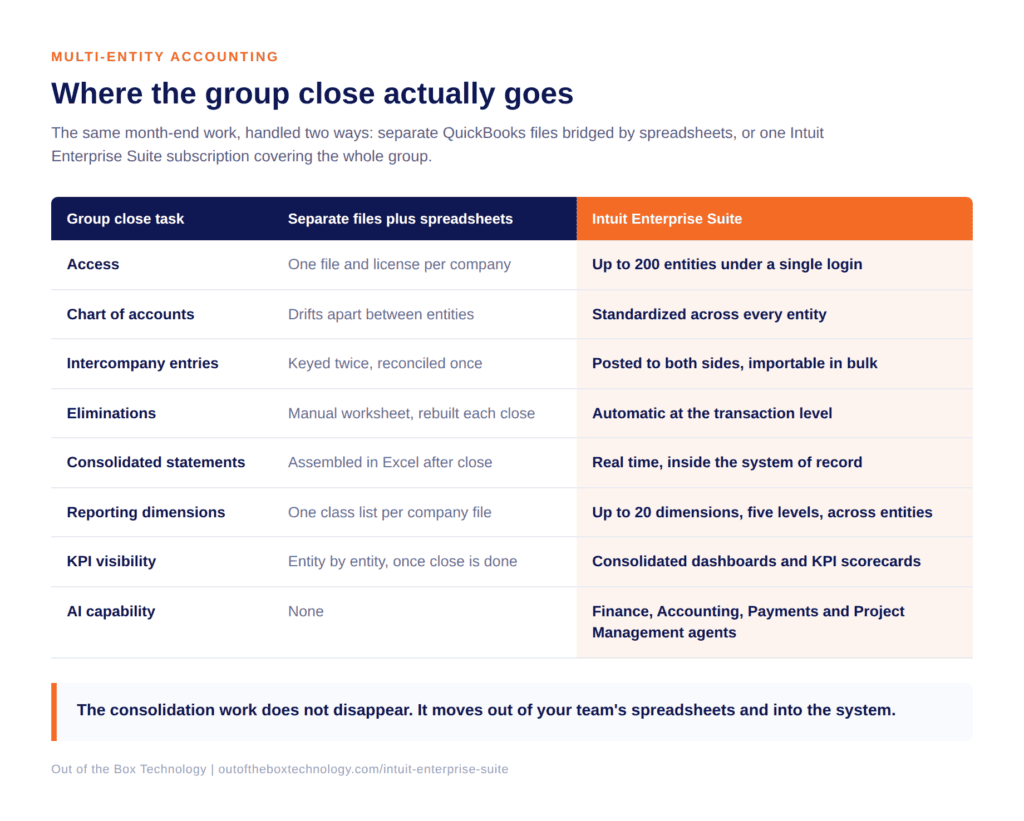
Intuit Enterprise Suite collapses that work into the system itself. Entities share a standardized chart of accounts, and users switch between the parent company and its subsidiaries from a dropdown rather than logging into separate files. Intercompany journal entries can be imported in bulk. Recent releases added automatic transaction-level eliminations and AI-driven auto-categorization for intercompany sales. Those two steps usually consume the most manual effort during a group close.
Reporting Across the Group Rather Than Company by Company
Consolidation is only half of the reporting story. Intuit Enterprise Suite supports up to 20 custom dimensions, each with unlimited values and up to five levels of hierarchy. A dimension is a tag that lets you filter and group financial results, similar to a class in QuickBooks but far more structured. Dimensions apply at the transaction line level, including accounts payable and receivable.
Those dimensions work across entities, which is the part that matters for a group. A private equity portfolio can report by sector across every holding at once. A franchise group can compare the same cost line across forty locations that sit inside six legal entities. A nonprofit with affiliated organizations can report by program and funding restriction across all of them, because funders ask for exactly that view.
Forecasting follows the same pattern. You can project profit and loss down to the dimension. Projections build from an existing budget or from the last three, six, nine, or twelve months of history, and they extend as far as three years out. Recent releases also added consolidated dashboards, AI-powered key performance indicator scorecards, three-way cash flow forecasting, management reports built for board packages, and calculated fields inside multi-entity reports.
The AI Agents Work Across the Whole Portfolio
Intuit has shipped four agents into Intuit Enterprise Suite, and each one targets a workload that gets heavier with every entity you add.
The Finance Agent handles reporting, key performance indicator analysis, and scenario planning, including forecasting against peer benchmarks. The Accounting Agent automates transaction categorization and assists with reconciliation. It can also pull data out of PDF statements, compare it against what is already in the system, and post it in one click. The Payments Agent works on collections, predicting which invoices are likely to be paid late and automating the reminder sequence. The Project Management Agent builds estimates, sets up plans and tasks, suggests profitability targets, and produces summaries with recommendations for the next job.
Consider what each of those does in a group setting. Reconciliation load multiplies by entity. So does categorization volume, collections follow-up, and the number of project reports somebody assembles by hand. Intuit reports that 78% of customers say its AI makes running the business easier, and 68% say it gives them more time for growth. In a multi-entity business, those hours come back several times over.
Automation has widened alongside the agents. The Sales Tax Agent gained a filing pre-check that scans for mismatches between your profit and loss and your sales tax liability report before you file. Approval workflows now support up to five parallel approvers with a detailed audit trail. Workflows can also be triggered by dimension, so a group can route approvals by entity, region, or department without building a separate process for each one.
Intuit’s Most Advanced Product, Without the ERP Project
Multi-entity companies have historically had two choices. Stay on QuickBooks and bridge the gaps with spreadsheets, or move to a traditional ERP and absorb a long implementation, a six-figure cost, and a retraining program. Intuit Enterprise Suite exists to remove that choice.
The platform is also where Intuit ships new capability first. Agentic AI, multi-dimensional reporting, consolidated KPI scorecards, and the deeper industry editions all land there ahead of anywhere else in the product line. Being on the platform means each release arrives in your environment automatically, without a procurement cycle or a migration project.
The adoption argument is quieter but usually decisive. Your controller already knows QuickBooks. The team is learning new capability rather than a new system, which is why multi-entity implementations here tend to be measured in weeks. Our guide to choosing an Intuit Enterprise Suite implementation partner covers what that work actually involves.
Which Multi-Entity Businesses Benefit Most
Private equity portfolio companies need standardized reporting across holdings and fast, defensible consolidations for the sponsor. Franchise groups need location-level profitability inside a manageable legal structure. Construction firms often run an entity per project or joint venture and need job costing that survives the consolidation. Real estate operators frequently run an entity per property. Nonprofits with affiliated organizations need program and grant reporting that rolls up cleanly.
In each case, entity count is a consequence of how the business is structured. The reporting requirement does not respect those boundaries. Leadership wants one number for the group and the ability to break it apart on demand.
Single Entity Businesses Still Fit
None of this rules out a single entity company. Picture a one-entity business with fourteen locations, four service lines, and project-based revenue. It often carries more reporting complexity than a holding company with three dormant subsidiaries. The dimensional reporting, the agents, and the approval workflows all deliver the same value inside one legal entity. Multi-entity capability is the ceiling rather than the entry requirement.
A Better Question Than “How Many Entities Do We Have”
Ask instead how long your group close takes, and how much of it happens outside your accounting system. Count the spreadsheets that sit between your entity-level books and the statements your board actually reads. Then ask who would be able to reproduce those files if that person left.
If the answers make you uncomfortable, the constraint is your architecture rather than your team. That is the problem Intuit Enterprise Suite was built to solve, and multi-entity groups are where the return shows up fastest.
How We Can Help
As an Intuit Enterprise Suite implementation partner, Out of the Box Technology helps businesses evaluate whether IES is the right fit, plan a migration path, and configure dimensions, intercompany automation, and reporting to match how the business actually operates. Our Intuit Enterprise Suite implementation guide walks through what that process looks like end to end.
If your team is weighing a move to Intuit Enterprise Suite or wants help putting these new features to work, reach out to the OOTB team to talk through next steps.
Related reading:
- What Is Intuit Enterprise Suite? A Guide for Growing Businesses
- Streamlining Multi-Entity Accounting with Intuit Enterprise Suite
- Intuit Enterprise Suite Spring 2026 Features
- QuickBooks Desktop to Intuit Enterprise Suite Migration: A Complete Walkthrough
- How Intuit Enterprise Suite Transforms Project Management and Job Costing