It’s the paradox that haunts most small business owners.
You look at your Profit & Loss statement. It’s a good month! You’re showing a healthy profit. You feel a moment of relief.
Then you look at your bank account.
The number staring back at you is nowhere near the profit on your P&L. You have payroll due Friday, a big vendor bill to pay, and a tax payment looming. Suddenly, that “profit” feels like a fantasy, and the familiar knot of cash-flow anxiety tightens in your stomach.
If this sounds familiar, you’re not alone. This is the classic symptom of a business that has outgrown its bookkeeping. For many SMBs, the default answer is to hire someone—a part-time bookkeeper, a full-time accountant. But this decision, often made in a panic, can lock you into a new set of expensive, hidden problems.
What if the solution wasn’t hiring someone, but partnering with a team?
This is the strategic shift to outsourced accounting, and its primary benefit isn’t just saving a few dollars. It’s about fundamentally changing your relationship with your finances—from reactive anxiety to proactive, data-driven confidence.
But how does it actually save you money? It’s not just about salary. The true savings are hidden in the costs you stop paying: the cost of errors, the cost of inefficiency, the cost of bad data, and the cost of missed opportunities.
Let’s break it down.
What Is Outsourced Accounting?
At its simplest, outsourced accounting is the business practice of hiring a third-party service provider to handle all or part of your company’s financial operations.
This isn’t just about “outsourcing bookkeeping” (though that’s a part of it). A modern outsourced accounting firm acts as your entire finance department, delivered virtually. They provide a full stack of services and expertise that scales with you.
This typically includes a combination of:
- Bookkeeping: The day-to-day work. Recording transactions, managing bills (accounts payable), invoicing clients (accounts receivable), and reconciling bank and credit card accounts.
- Accounting (Controller-Level): The oversight. Closing the books accurately each month, preparing financial statements (P&L, Balance Sheet, Cash Flow), managing payroll, and ensuring tax compliance.
- Strategic Advisory (Fractional CFO): The future-focused guidance. This is the high-level expertise you need but can’t afford full-time. A fractional CFO helps with cash flow forecasting, budgeting, strategic planning, KPI (Key Performance Indicator) tracking, and providing the financial insights you need to make smart business decisions.
Instead of one person, you get a dedicated team—a bookkeeper, a controller, and a CFO—all for a single, predictable monthly fee.
The Monster in the Closet: The Real Cost of an In-House Finance Team
To understand how outsourcing saves money, you must first understand the true, fully-loaded cost of hiring in-house. The salary is just the tip of the iceberg.
Let’s run the numbers on a single, mid-level in-house accountant.
According to 2024-2025 data, the median salary for a staff accountant is around $79,880. A more senior-level accountant or controller will easily push into the $85,000 – $150,000 range.
But you don’t just pay the salary. This is where it gets expensive.
- Taxes & Benefits (30-40%): The “fully-loaded” cost. Add 30-40% for payroll taxes (FICA, FUTA, SUTA), health insurance, retirement contributions, and workers’ comp.
- $79,880 Base Salary + 35% Burden = $107,838 per year.
- Recruitment (Avg. $4,700): The cost to find them. According to Glassdoor, the average US company spends about $4,700 per new hire on job postings, background checks, and the internal time spent interviewing.
- Training ($1,500 – $5,000 annually): The cost to keep them sharp. You need to pay for continuing education, software training (like QuickBooks), and professional development to keep their skills current.
- Technology & Software ($3,000 – $10,000 annually): The tools for the job. You’re now on the hook for QuickBooks licenses, payroll software, bill pay platforms, and IT support.
- Overhead: The cost of a chair. You have to provide a computer, a desk, office space, and all the incidentals that go with it.
- Turnover (50-200% of Salary): The “oh, no” cost. When (not if) that person leaves, the Work Institute reports it can cost between 50% and 200% of their annual salary to replace them. That’s $40,000 – $150,000+ in lost productivity, new recruitment costs, and training for their replacement.
When you add it all up, your $79,880 accountant is actually a $120,000+ annual expense—and that’s for one person who likely doesn’t have the strategic expertise of a CFO or the fraud-prevention controls of a full team.
How Outsourced Accounting Actually Saves You Money: 7 Ways
This is where the math flips. Outsourced accounting doesn’t just cut these costs; it eliminates most of them and delivers far more value for the price.
1. You Slash Direct Employment & Overhead Costs (The Obvious Win)
This one is simple. With an outsourced firm, you pay one predictable monthly fee.
- NO salaries.
- NO benefits or payroll taxes.
- NO recruitment or training costs.
- NO vacation or sick pay to cover.
- NO overhead for office space or equipment.
A full-service outsourced accounting plan that includes bookkeeping, controller services, and fractional CFO advisory might range from $2,000 to $7,000 per month.
Compare that:
- In-House Controller: $150,000+ (fully-loaded)
- Outsourced Team (Bookkeeper + Controller + CFO): $60,000 / year (at $5,000/mo)
The savings are immediate and substantial. Businesses often report saving 30-50% compared to the cost of an in-house team with comparable expertise.
2. You Get a Full Team for the Price of One Person
When you hire one in-house accountant, you get one person’s skillset. You’re forced to find a “unicorn” who is both a detail-oriented bookkeeper and a high-level strategic CFO. This person doesn’t exist.
With an outsourced firm, you get an entire, segregated team:
- The Bookkeeper manages daily transactions.
- The Controller reviews the work, closes the books, and ensures accuracy.
- The Fractional CFO analyzes the data and provides strategic guidance.
This segregation of duties is the #1 defense against errors and fraud. One person can’t control the cash and record the transactions and review their own work. An outsourced team has these internal controls built-in, which studies show can improve fraud prevention by 40-60%.
3. You Stop Paying for Expensive Accounting Technology
Your in-house accountant needs tools. That means you buy, maintain, and support the software. This often includes:
- QuickBooks Desktop or Online (and the right subscription level)
- Payroll processing (e.g., Gusto, ADP)
- Bill pay and expense management (e.g., Bill.com, Dext)
- IT support and data backups
A professional outsourced accounting firm lives and breathes this technology. They have a “best-in-class” tech stack that they’ve already perfected, and the cost is built into their fee. They are QuickBooks experts (like us!) and can optimize a workflow that automates data entry, saving time and reducing errors. You get the benefit of a $10,000+ tech stack without paying a dollar for the licenses.
4. You Dramatically Reduce Costly Errors and Compliance Risk
Accounting errors are silent killers. A miscategorized expense, a missed tax deadline, or a poorly reconciled account can cost you thousands in penalties, overpaid taxes, or just bad business decisions based on bad data.
- Data Point: Studies have shown that outsourced accounting teams can reduce accounting errors by as much as 80%.
- Compliance: Do you know the specific sales tax nexus rules in the three new states you shipped to? Your outsourced team does. They are specialists who stay on top of ever-changing tax laws and compliance rules, shielding you from IRS penalties (which can be massive).
5. You Unlock Scalability (Up and Down)
Your business isn’t static. You have busy seasons and slow seasons. You have rapid growth spurts.
- In-House: You’re in a bind. If you get busy, your one accountant is overwhelmed, books get messy, and you have to hire. If you slow down, you’re paying a $100k+ salary for work that isn’t there.
- Outsourced: Your service scales with you. As your transaction volume and complexity grow, you simply adjust your service plan. You pay for exactly what you need, when you need it. This flexibility is invaluable for managing cash flow.
6. You Regain Your Most Valuable Asset: Time
This is the hidden saving that might be the biggest of all. As a business owner, your time is the most valuable and finite resource you have.
- Data Point: Business owners who switch to outsourced accounting report regaining 10-15 hours per week.
What is that time worth to you?
That’s 10-15 more hours you can spend on sales, product development, team leadership, or whatever your “core business” actually is. Stop wasting your best energy trying to be a second-rate accountant and get back to being a first-rate CEO.
7. You Turn Your Biggest Cost Center into Your Sharpest Strategic Tool
For most SMBs, accounting is a backward-looking cost center. It’s a necessary evil that tells you what you did last month.
With a good outsourced firm (especially one with fractional CFO services), your finance department becomes a forward-looking strategic asset.
Instead of just getting a P&L, you get answers:
- “Why is my profit high but my cash low?” (You need to tighten your invoicing or manage inventory.)
- “Which of my services is actually the most profitable?” (Let’s look at a profit-by-service report.)
- “Can I afford to hire two new salespeople?” (Let’s build a cash flow forecast to model it out.)
This is the data that unlocks real, sustainable growth. The savings here aren’t in dollars cut, but in the thousands of dollars earned from making smarter decisions.
Frequently Asked Questions (FAQs) About Outsourced Accounting
1. What’s the difference between outsourced bookkeeping and outsourced accounting?
- Outsourced Bookkeeping is focused on the past. It’s the essential daily recording of transactions to get your books clean and up-to-date.
- Outsourced Accounting is focused on the present and future. It includes bookkeeping, but adds the controller-level review to ensure accuracy (closing the books) and the fractional CFO-level strategy to use that data for planning and growth.
2. At what size is my business ready for this? You don’t have to be a multi-million dollar company. In fact, outsourcing is most valuable for businesses in the $250k to $10M revenue range. This is the “no-man’s-land” where you’re too complex for DIY spreadsheets (or a part-time bookkeeper) but not big enough to justify a $200k+ in-house finance department.
3. Will I lose control of my finances? No, you will gain more control. Right now, you might have a “black box” where you’re not sure if the numbers are right. With a professional firm, you get 24/7 access to your data (it’s your QuickBooks file), and you receive regular, accurate, and easy-to-understand reports. You move from guessing to knowing.
4. What does the onboarding process look like? It’s typically a 30-90 day process.
- Discovery: The firm does a deep dive into your current books, processes, and tech.
- Clean-Up: They’ll fix any historical errors to build a clean foundation.
- Design: They’ll build your new, efficient tech stack and workflow.
- Launch: You go-live with the new, streamlined process, and your team takes over the daily work.
The Bottom Line: Stop Buying a Salary, Start Investing in an Asset
Hiring an in-house accountant means buying a salary and hoping for the best.
Partnering with an outsourced accounting firm means investing in a scalable, expert system designed to protect you from risk and provide the financial clarity you need to grow.
The savings are clear:
- You save 30-50% on the hard costs of salary, benefits, and overhead.
- You save thousands by eliminating costly errors, fraud, and technology expenses.
- You gain hundreds of hours of your own time back.
- You unlock immeasurable value by making smarter, data-driven decisions.
It’s time to get out of the reactive scramble and build a financial foundation you can trust.
Ready to See the Math for Your Business?
You’ve seen the data. Now, let’s run your specific numbers. The team at Out of the Box Technology can provide a free, no-obligation analysis to show you the true cost of your current accounting and build a custom, flat-fee proposal for our outsourced services.
 Step 1: Pre-Migration Assessment
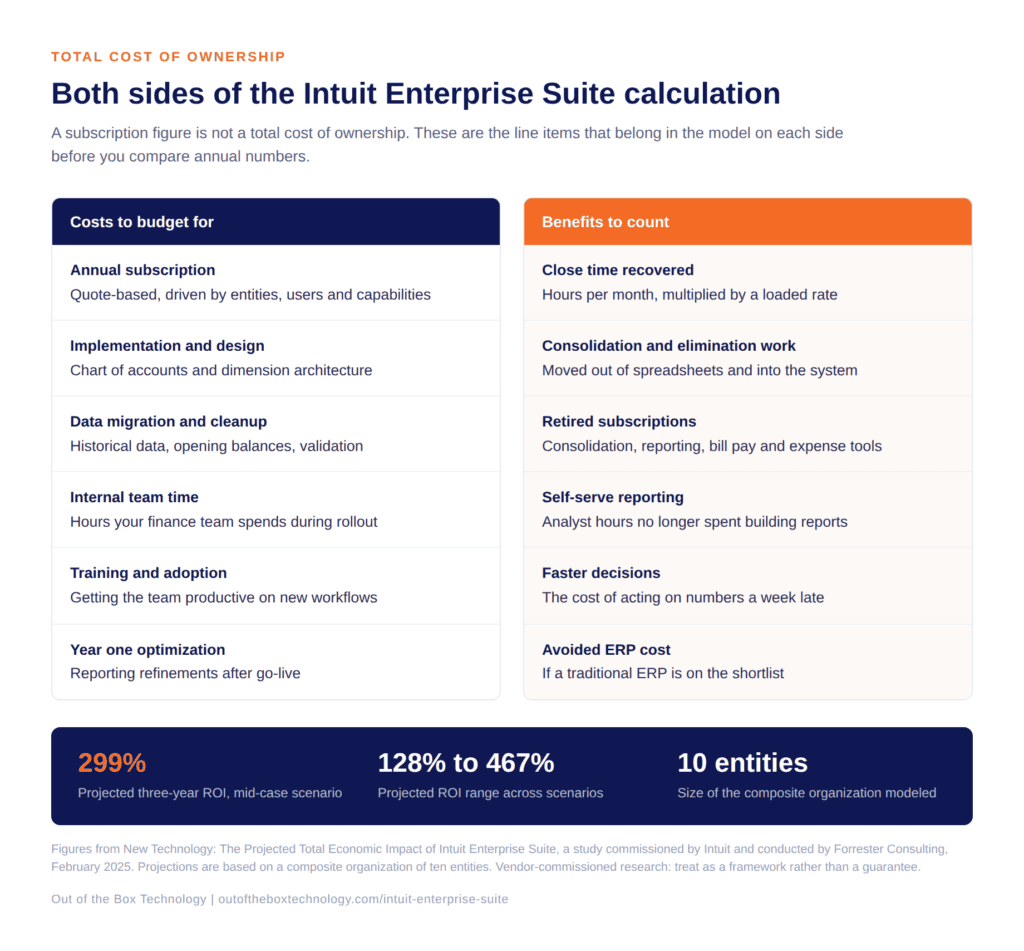 On the cost side, budget for implementation and system design, data migration and cleanup, and internal team time during the rollout. Add training and whatever ongoing optimization you expect in year one. Design work is the line item most often underestimated. Your chart of accounts and dimension architecture determine whether the reporting still works in five years, or whether it needs rebuilding in eighteen months.