Thas why is imperative you develop a solid tax compliance and payroll processing plan to prevent possible payroll fees and errors. Here are 5 payroll mistakes to avoid.
March 16, 2025
5 Common Payroll Mistakes And How To Avoid Them

Talk to An Advisor Today
You might also like these articles
Intuit Enterprise Suite vs NetSuite: What Growing Businesses Need to Know
Read More
Intuit Enterprise Suite vs NetSuite: A Smarter Way to Evaluate Your ERP If you’re comparing Intuit Enterprise Suite vs NetSuite, you’re likely at a turning point. Your current system works… but it’s starting to slow you down.Reporting takes too long. Integrations feel fragile. Costs keep creeping up. This can be especially true for Construction businesses….

Intuit Enterprise Suite Training: From Setup to Smarter Decisions, Faster
Read More
Most companies don’t struggle with implementation. They struggle with adoption. They invest in powerful tools like Intuit Enterprise Suite, but teams never fully use dimensions, reporting, or AI features the way they’re meant to be used. That’s where Intuit Enterprise Suite training makes the difference. Done right, it turns the platform from a system you…
Intuit Enterprise Suite Roles and Permissions: How to Set Up Secure, Scalable Access for Your Finance Team
Read More
As your business grows, so does the complexity of your financial systems. More users. More entities. More sensitive data. And this is where Intuit Enterprise Suite roles and permissions become critical. Without a structured approach to access, finance teams often run into: Too many users with broad access Accidental changes to financial data Lack of…
Intercompany Eliminations in Intuit Enterprise Suite: A Step-by-Step Guide for Multi-Entity Finance Teams
Read More
Managing multiple entities doesn’t just add complexity. It multiplies it. Intercompany invoices. Internal loans. Shared expenses. Cross-entity allocations. And this is exactly where intercompany eliminations and Intuit Enterprise Suite become critical. Without a structured approach, these transactions distort your financials, slow your close, and make it harder to trust your numbers. With intercompany eliminations in…
Claim your complimentary bookeeping assesment today
Request your free bookkeeping quote today and let us simplify your financial management. Our expert team at QuickBooks is ready to tailor a solution to your needs.
April 10, 2026
Intuit Enterprise Suite Training: From Setup to Smarter Decisions, Faster
Business Software & Apps, Free Resources, News & Resources, QuickBooks, Recent News, Small Business Accounting
Most companies don’t struggle with implementation.
They struggle with adoption.
They invest in powerful tools like Intuit Enterprise Suite, but teams never fully use dimensions, reporting, or AI features the way they’re meant to be used.
That’s where Intuit Enterprise Suite training makes the difference.
Done right, it turns the platform from a system you have into one your team actually relies on to make decisions.
Why Intuit Enterprise Suite Training Matters More Than Setup
Intuit Enterprise Suite is designed to streamline financial management, reporting, and operations across your business.
It can handle:
- Multi-entity reporting
- Inventory and operational workflows
- Automated financial processes
- Real-time data insights
But none of that matters if your team is:
- Working around the system
- Exporting data into spreadsheets like Microsoft Excel
- Unsure how to use dimensions or reporting properly
Training isn’t just about learning features.
It’s about changing how your team works day to day.
Build Structured Learning Paths (Not One-Off Training)
A single onboarding session won’t stick.
Effective Intuit Enterprise Suite training is structured, progressive, and role-specific.
1. Foundations
Start with the basics:
- Implementation
- Navigation and workflows
- Core financial processes
- Introduction to dimensions and reporting
2. Role-Based Training
Tailor training to how people actually use the system:
- Finance → consolidations, reporting, forecasting
- Operations → tracking projects, costs, or inventory
- Leadership → dashboards and decision-making insights
3. Advanced Capabilities
Layer in more value over time:
- Custom reporting
- Multi-dimensional analysis
- AI-driven insights and automation
The goal is simple: people learn what they need, when they need it, and build confidence as they go. The Intuit Academy can be a great resource for keeping your team up to date.
Make Dimensions and Reporting Practical (Not Theoretical)
Dimensions are one of the most powerful parts of Intuit Enterprise Suite.
They let you:
- Track profitability by project, location, or customer
- Compare performance across entities
- Build flexible, real-time reports
But they’re often underused because training stays too conceptual.
Instead, anchor training in real use cases:
- “Here’s how we track profitability by job”
- “Here’s how leadership reviews performance weekly”
- “Here’s how we eliminate manual reporting”
When people see how it applies to their role, adoption becomes much easier.
Train for Better Decisions, Not Just Better Usage
Most training focuses on how to use the system.
The real value is in what it enables.
Strong Intuit Enterprise Suite training should answer:
- What reports actually matter?
- What metrics do we track consistently?
- How do we make faster decisions with this data?
Focus on:
- Standardized dashboards
- Clear reporting structures
- Consistent definitions of key metrics
If your team logs in and immediately sees what matters, usage becomes natural.
Align Training With Your Tech Stack (Not Just the Platform)
One of the biggest gaps in Intuit Enterprise Suite training is treating it like a standalone tool.
In reality, it sits at the center of your broader tech stack.
That includes:
- CRM systems like Salesforce or HubSpot
- Payroll and HR tools
- Marketing platforms
- Industry-specific software
If your training doesn’t reflect how these systems connect, your team will default back to manual workarounds.
Instead, training should show how data flows across your business.
For example:
- How financial data connects to CRM insights for better forecasting
- How payroll and operational data feed into reporting
- How integrations reduce duplicate data entry and errors
This is especially important for growing businesses managing multiple entities or complex workflows.
When teams understand how Intuit Enterprise Suite fits into the bigger picture, they’re far more likely to trust the system, and use it consistently.
Standardize Workflows Early
Another key part of effective training is standardization.
Without it, every team member ends up using the platform slightly differently:
- Different naming conventions
- Inconsistent use of dimensions
- Manual reporting variations
Over time, this creates messy data and unreliable reporting.
Strong Intuit Enterprise Suite training should include:
- Clear naming conventions for dimensions and reports
- Defined processes for entering and managing data
- Standard reporting templates used across teams
This doesn’t just improve efficiency.
It improves confidence in the data, which is what ultimately drives adoption.
Reduce Reliance on Spreadsheets
A common sign that training isn’t working?
Teams are still exporting data into Excel to “make it usable.”
While spreadsheets will always have a place, they shouldn’t be the default.
Training should actively address this by showing:
- How to build reports directly in the platform
- How to customize dashboards for different roles
- How to automate recurring reporting
The goal is to shift from:
➡️ “Pull data and fix it manually”
➡️ To “Trust the system and use it in real time”
That shift is where the real ROI happens.
Introduce AI in a Way That Feels Useful
AI features can be powerful, but they’re often underused.
Not because they’re complex, but because they’re not positioned clearly.
Keep it simple:
- Automate repetitive workflows
- Identify trends or anomalies using Predictive analytics
- Speed up reporting and analysis
Instead of “AI training,” frame it as:
- Saving time
- Reducing manual work
- Improving accuracy
That’s what drives real adoption.
Build Internal Champions to Drive Adoption
External training gets you started.
Internal champions make it stick.
These are the people who:
- Go deeper into the platform
- Help others troubleshoot
- Reinforce best practices daily
Start small:
- 1–2 people in finance
- 1 in operations
- Optional: 1 leadership stakeholder
Give them:
- Deeper training
- Ownership of best practices
- Access to new features and updates
This creates ongoing momentum instead of one-time learning.
Create a Simple Resource Hub Your Team Will Actually Use
People forget things. That’s normal.
What matters is giving them an easy way to get unstuck.
Your Intuit Enterprise Suite training should include a central hub with:
- Short how-to videos
- Step-by-step guides for common workflows
- Reporting templates
- FAQs based on real questions
Keep it simple and searchable.
The goal is not more documentation.
It’s less friction.
Measure What’s Actually Working
Training should lead to clear, measurable outcomes.
Track things like:
- Platform usage and feature adoption
- Reduction in manual reporting
- Time saved on key workflows
- Reporting accuracy and consistency
But the real signal is this:
Are decisions getting faster and clearer?
If they are, your training is working.
Final Thought
Most teams don’t need more tools.
They need to get more value from the ones they already have.
With the right approach to Intuit Enterprise Suite training—structured learning paths, internal champions, and practical resources—you unlock better reporting, faster insights, and real adoption across your business.
And that’s when the platform starts driving real results.
A Quick Note from the OOTB Team
If your team isn’t fully using dimensions, reporting, or AI features the way they should, you’re not alone.
This is a common inflection point for growing businesses using Intuit Enterprise Suite.
The platform is powerful, but without the right training structure and internal alignment, teams often revert to manual workarounds or inconsistent use.
We work with businesses to design training approaches, reporting structures, and workflows that actually stick, so teams can trust the system and use it day to day.
If you’re thinking about getting more out of your setup, it might be worth a quick conversation.
Schedule a consultation today!
Talk to An Advisor Today
You might also like these articles
Is Intuit Enterprise Suite Worth It? ROI and Total Cost of Ownership Explained
Read More
Intuit does not publish a list price for Intuit Enterprise Suite. Every quote is built around your entity count, user count, and the capabilities you turn on, which means you cannot answer the worth-it question from a pricing page the way you can with QuickBooks Online. That makes the evaluation harder than it needs to…
Intuit Enterprise Suite Multi-Entity Accounting: Why It Is Not Just a Single Entity Upgrade
Read More
Most businesses meet Intuit Enterprise Suite for the first time as a step up from QuickBooks Online Advanced. More users, better reporting, the same familiar interface. That introduction is accurate as far as it goes, and it undersells the product badly. Intuit built this platform for groups. A single login can manage more than 200…
Intuit Enterprise Suite Summer Release: What’s New for Growing Businesses
Read More
The Intuit Enterprise Suite Summer Release goes live on August 12, 2026. Every feature in this rollout is now available directly in product. This release adds real depth in two areas. It changes how you report on your business, and how fast you can close the books across entities. That matters for businesses running multiple…
Migrating Historical Financial Data to Intuit Enterprise Suite: How Much History Do You Really Need?
Read More
Most companies planning a move to Intuit Enterprise Suite ask the wrong first question. They ask how to migrate their history, when the question that actually shapes cost, timeline, and reporting quality is how much of it to bring when thinking about historical data migration in Intuit Enterprise Suite. For most mid-market businesses, the answer…
Claim your complimentary bookeeping assesment today
Request your free bookkeeping quote today and let us simplify your financial management. Our expert team at QuickBooks is ready to tailor a solution to your needs.
August 13, 2026
Intuit Enterprise Suite Summer Release: What’s New for Growing Businesses
The Intuit Enterprise Suite Summer Release goes live on August 12, 2026. Every feature in this rollout is now available directly in product. This release adds real depth in two areas. It changes how you report on your business, and how fast you can close the books across entities. That matters for businesses running multiple entities, tracking project profitability, or managing inventory across locations. It also introduces smaller updates across multi-entity operations, projects, inventory, AI, business intelligence, single sign-on, and workforce management. For background on the platform, see what Intuit Enterprise Suite is and who it is built for and Intuit’s own product overview.
Release Highlight: Reporting That Finally Matches How Your Business Runs
Every business is more than a single bottom line. Regions, departments, product lines, and cost centers sit underneath the totals. Each one tells a different part of the story. Intuit Enterprise Suite has offered classes for this kind of tracking, but classes cap out at one attribute per transaction line. Dimensions remove that ceiling.
More attributes, fewer workarounds
With this release, businesses can tag a single transaction with up to 20 attributes instead of one. Dimensions now work everywhere classes do, across both reports and transactions. Several additions close long-standing gaps. Dimensions now apply to Time entries, billable expenses, and recurring payment transactions. Users can also assign a dimension at the header level of an invoice instead of line by line. A new Balance Sheet by Dimensions report is rolling out in beta for single-entity companies. Project-based businesses gain eight additional dimension-based reports, including cost to complete and work in progress. Reparenting dimensions is also now supported, so reporting structures can evolve as a business grows.
Why it matters for reporting
For a construction or professional services company running multiple divisions, this means real answers fast. A question like “what is our margin in the Southwest for commercial accounts” becomes a single report. No exporting to Excel. No rebuilding a pivot table every month. Dimensions also feed directly into budgeting and forecasting. Teams can set targets and track variance at whatever level of detail actually matches the business. Getting the most out of dimensions usually comes down to setup and adoption. That is why OOTB built dedicated Intuit Enterprise Suite training around exactly this feature.
Release Highlight: Closing Faster Across Every Entity
Multi-entity businesses know the intercompany close eats time every single period. Last spring, Intuit Enterprise Suite moved intercompany eliminations from a reporting-time exercise into a real-time, transaction-level calculation. This release builds directly on that foundation.
Smart automation for intercompany entries
Intercompany Journal Entry Smart Complete now detects the transaction type based on the lines a user enters. It automatically generates the required due-to and due-from entries, intercompany contacts, and partner company assignments. The user supplies the business intent, and the platform handles the accounting structure underneath it. Recurring templates are now generally available, letting teams turn repeating intercompany journal entries and dynamic allocations into templates. Those templates run automatically each period instead of being rebuilt by hand.
Auto-posting rounds out the automation. Businesses can define a mapping that ties a selling company, a product or service, and a buying company to a specific category. When that mapping is active, matching bills skip manual review. They post automatically.
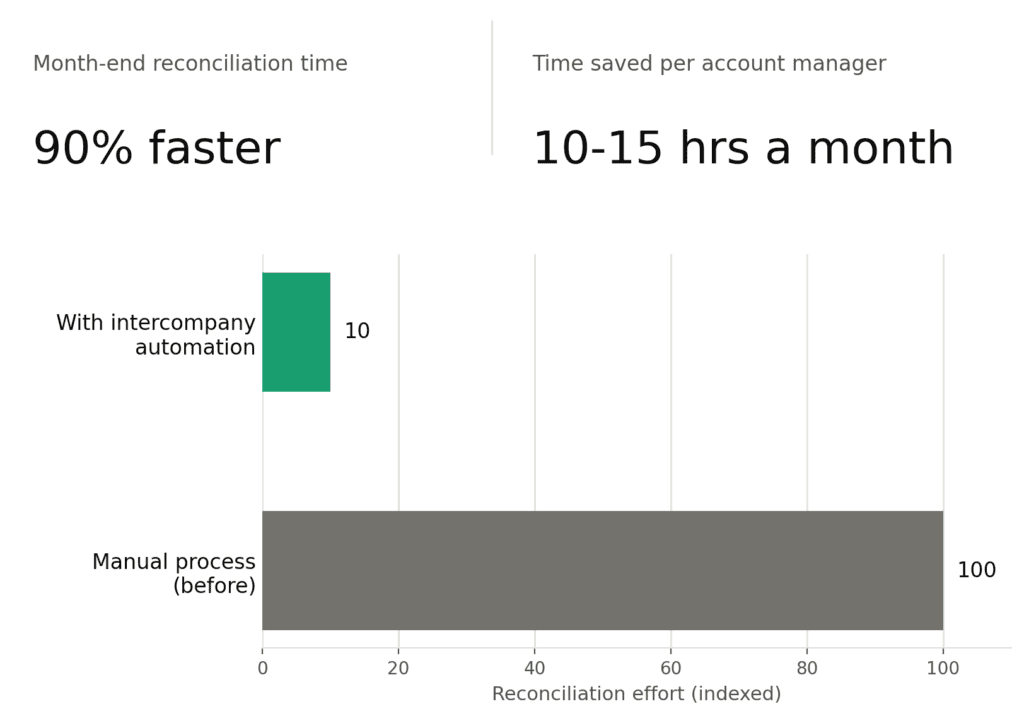
The impact on close time
Customers piloting these tools have reported meaningful time savings. One account management team estimated 10 to 15 hours saved per manager each month. Another cited a 90 percent drop in month-end intercompany reconciliation time during peak season. As with existing intercompany eliminations, the platform surfaces recommendations rather than acting unilaterally. Automation only runs where a business has explicitly turned it on. This kind of automation matters most for businesses consolidating multiple QuickBooks files into a single Intuit Enterprise Suite instance. Intercompany transactions there were previously tracked by hand.
More Updates Across Intuit Enterprise Suite
Multi-entity
Multi-entity operations pick up Cross-Company Bill Payment. It lets a business record a bill payment in one entity using a bank account that belongs to another. The intercompany accounting is handled automatically. Multi-level entity hierarchies, introduced last spring for consolidated reporting, now extend into KPIs and dashboards as a beta feature. Multi-currency management is also getting a significant upgrade in beta. Exchange rates are now managed in a single protected table. Businesses get clearer visibility into how rate changes affect transactions, plus automatic unrealized gain and loss calculations. That multi-currency beta is currently limited to organizations with a U.S. dollar functional currency, with support for international currencies expected this fall. These additions build on the multi-entity hub and hierarchy work from the Intuit Enterprise Suite Spring 2026 release, continuing a pattern of quarterly investment in cross-entity operations.
Projects
Project-based businesses gain two new reports: Open Purchase Orders by Project and Project Costs by Vendor. Users can also apply dimension filtering directly on project reports. Ship-to addresses on purchase orders now default automatically to a project’s site address, and payroll can be split across projects. A beta feature for project-specific user permissions will let businesses restrict project manager access to only their assigned projects. AI suggests assignments where a company has multiple managers and projects in play.
Inventory
Units of Measure let businesses order, receive, and sell the same item in different quantities, such as the case, the pack, or the individual unit. No more forcing every transaction into a single measurement. Invoices now also support multiple shipping addresses per customer. Users can select from a saved list instead of retyping an address each time a customer orders to a different location.
AI
Intuit Intelligence is expanding with a new natural-language chat interface in beta. Users can ask questions and generate insights across entities without building a custom report first. Chart of Accounts standardization now supports applying a standard structure to a subset of entities rather than the whole organization. Businesses migrating from QuickBooks Online or QuickBooks Desktop also gain a beta tool. It suggests how to reclassify existing Locations or Custom Fields into dimensions, based on prior transaction history.
Business Intelligence
Business Intelligence tools are also getting sharper. The KPI scorecard now supports Class and Dimension filters, along with drill-down access into any individual metric. Management reports in the consolidated view can generate AI-written executive summaries. They also include smart chips that update automatically as underlying data changes. Multi-level grouping now supports up to six nested dimensions with drag-and-drop reordering. Two beta features, multi-dimension Display By reports and multi-dimensional pivots, allow deeper cross-tabulation directly in the platform, with no need to export to a spreadsheet.
Single sign-on
Single sign-on support now allows businesses to provision and manage Intuit Enterprise Suite access through Google, Okta, or EntraID. Access is revoked automatically the moment an employee leaves the company.
Workforce Solutions
Workforce Solutions adds dimension integration with Time and Payroll in beta. Payroll admins can split paychecks across dimension values. A beta custom report builder for Payroll is also included.
What This Means If You Are Evaluating Intuit Enterprise Suite
Many of the features in this release are rolling out through Intuit’s Early Access Program between August and October before reaching general availability, so the experience will keep evolving through the fall. For businesses currently running QuickBooks Desktop or QuickBooks Online and outgrowing what those platforms can report on, or for multi-entity organizations still closing the books manually across subsidiaries, this release is a good moment to take a closer look at what Intuit Enterprise Suite can now do. For a fuller record of how the platform has progressed release over release, Intuit’s own Spring 2026 Intuit Enterprise Suite release notes are worth a read alongside this summer update.
How We Can Help
As an Intuit Enterprise Suite implementation partner, Out of the Box Technology helps businesses evaluate whether IES is the right fit, plan a migration path, and configure dimensions, intercompany automation, and reporting to match how the business actually operates. Our Intuit Enterprise Suite implementation guide walks through what that process looks like end to end.
If your team is weighing a move to Intuit Enterprise Suite or wants help putting these new features to work, reach out to the OOTB team to talk through next steps.
Related reading:
- Intuit Enterprise Suite Implementation Partner
- Step-by-Step Guide to Preparing for an Intuit Enterprise Suite Migration
- Chart of Accounts Migration to Intuit Enterprise Suite: A Controller’s Guide
- Migrating QuickBooks Online Advanced to Intuit Enterprise Suite
- 7 Critical Financial Reports to Run Before You Close the Fiscal Year
Frequently Asked Questions
What is included in the Intuit Enterprise Suite Summer 2026 release?
What are dimensions in Intuit Enterprise Suite, and how are they different from classes?
Do I need to do anything to access the Summer 2026 release features?
What is Intercompany Journal Entry Smart Complete?
How much time can intercompany automation save my accounting team?
Which Summer 2026 features are still in beta, and how do I access them?
How do I get help implementing these new Intuit Enterprise Suite features?
Talk to An Advisor Today
You might also like these articles
Is Intuit Enterprise Suite Worth It? ROI and Total Cost of Ownership Explained
Read More
Intuit does not publish a list price for Intuit Enterprise Suite. Every quote is built around your entity count, user count, and the capabilities you turn on, which means you cannot answer the worth-it question from a pricing page the way you can with QuickBooks Online. That makes the evaluation harder than it needs to…
Intuit Enterprise Suite Multi-Entity Accounting: Why It Is Not Just a Single Entity Upgrade
Read More
Most businesses meet Intuit Enterprise Suite for the first time as a step up from QuickBooks Online Advanced. More users, better reporting, the same familiar interface. That introduction is accurate as far as it goes, and it undersells the product badly. Intuit built this platform for groups. A single login can manage more than 200…
Migrating Historical Financial Data to Intuit Enterprise Suite: How Much History Do You Really Need?
Read More
Most companies planning a move to Intuit Enterprise Suite ask the wrong first question. They ask how to migrate their history, when the question that actually shapes cost, timeline, and reporting quality is how much of it to bring when thinking about historical data migration in Intuit Enterprise Suite. For most mid-market businesses, the answer…
Private Equity Accounting: How to Make Your Company Attractive to Buyers
Read More
Private equity firms are sitting on close to $1.1 trillion in dry powder in the United States, and after several slower years, 2026 is shaping up as a year of real deployment. According to Cherry Bekaert’s 2026 private equity outlook, aggregate deal value crossed $1 trillion in 2025 for only the second time on record,…
Claim your complimentary bookeeping assesment today
Request your free bookkeeping quote today and let us simplify your financial management. Our expert team at QuickBooks is ready to tailor a solution to your needs.
July 13, 2026
Private Equity Accounting: How to Make Your Company Attractive to Buyers
Private equity firms are sitting on close to $1.1 trillion in dry powder in the United States, and after several slower years, 2026 is shaping up as a year of real deployment. According to Cherry Bekaert’s 2026 private equity outlook, aggregate deal value crossed $1 trillion in 2025 for only the second time on record, and lower borrowing costs are expected to carry that momentum forward. For a business owner weighing a sale, that sounds like good news. It is, but only for the right kind of company.
PwC’s midyear 2026 deals outlook found that buyers are increasingly rewarding businesses with durable, demonstrated growth rather than speculative upside, and the middle market has grown less forgiving of the gap between what a seller believes a business is worth and what a buyer’s due diligence team can actually support. Sponsors have capital to deploy and more competing opportunities than they can act on, and they walk away quickly the moment a data room raises more questions than it answers.
What private equity buyers evaluate, underneath the deal terminology, comes down to two questions: how much risk is hiding in the numbers, and how much growth is realistically ahead. Private equity accounting, done well ahead of a sale process, is what answers the first question before a buyer ever has to raise it. The companies that earn premium valuations tend to share one trait long before a deal is ever discussed. They operate as though a buyer could walk through the door tomorrow, because for the ones who prepare early, eventually one does.
Run the Business Like It Is Always for Sale
The biggest mindset shift a business owner can make has little to do with accounting software or reporting templates. It comes down to a decision, made well before a sale is on the table, to run the company as though due diligence could begin next quarter.
In practice, that means closing the books on a monthly cadence instead of catching up every quarter, documenting the reasoning behind pricing decisions, vendor contracts, and compensation instead of keeping that knowledge with the owner alone, and separating personal expenses from the business rather than running them through it. A buyer’s advisors will find those expenses eventually, and every dollar they flag gets subtracted from the number used to calculate value.
Owners who hold themselves to this standard tend to notice something else along the way. The business gets healthier and more profitable, independent of any future transaction. Clean financials surface problems early. Documented processes reduce the business’s dependency on any one person’s memory. None of it requires an active sale process to pay off.
The alternative is expensive. A rushed cleanup effort in the final six months before a deal, once a business is already mid-process, means reconstructing records under deadline, explaining gaps to a skeptical buyer, and negotiating from a weaker position because the seller needs the deal to close more than the buyer needs it to happen. Sponsors read that urgency in the data room, and it shows up in the price.
Private Equity Accounting: Get the Books in Order, and Keep Them There
If one factor kills more deals or compresses more multiples than anything else, it is the state of the books. Research from CLA’s transaction advisory practice found that quality of earnings issues and discrepancies in earnings before interest, taxes, depreciation, and amortization (EBITDA) uncovered during diligence, together, account for nearly half of failed transactions, ahead of financing problems or a change of heart on either side of the table. Roughly one in three signed letters of intent never reaches a closing, and accounting is usually the reason.
Private equity accounting is less a one-time clean-up project than a standard the business holds itself to every month. Private equity firms scrutinize financials before almost anything else because financials are the input to every other decision they make. The purchase price, the debt structure, and the earnout terms all trace back to a number the buyer’s diligence team has to trust. A business that cannot produce clean, consistent financials is asking a sponsor to underwrite a guess.
One of the more consequential decisions many owners face along the way is whether to remain on cash basis accounting or move to accrual. Cash basis books record revenue and expenses when money changes hands, which is simple but distorts the timing of both. Accrual accounting matches revenue to the period it was earned and expenses to the period they were incurred, which is what most buyers and their lenders expect to see, and what a quality of earnings analysis is built to evaluate. Making that switch well before a sale process begins, rather than converting historical records under deadline, keeps the transition itself from becoming a red flag.
The payoff for clean, timely financials goes beyond avoiding trouble. A business that can produce audit-ready records on short notice expands its own buyer pool, because more sponsors and lenders are willing to move quickly on it, and a wider pool of interested buyers is what creates real competition for a deal. Whether a given business needs a full audit or a lighter review depends on its size, its industry, and what a particular buyer’s lenders require, and that question is worth a direct conversation with an accounting partner rather than a guess. Cleaning up historical books before that conversation happens tends to shorten it considerably.
The red flags that trigger a re-trade or a walked deal stay fairly consistent across industries: revenue recognized before it is actually earned, expenses capitalized instead of recorded when incurred, sub-ledgers that will not reconcile to the financial statements, and reported earnings that outpace operating cash flow. That last item is worth checking before a buyer ever does. Analysts often compare cash flow from operations to net income as a quick test, and a ratio that sits consistently below 1.0 tends to raise questions about whether the earnings are as real as they look on paper.
What a Larger Buyer Pool Means for the Deal
Clean financials and clear KPIs do more than pass a diligence checklist. They widen the field of buyers who can seriously consider a business, and a wider field is what creates competitive tension.
Strategic buyers and financial buyers look at the same data room with different questions in mind. A strategic acquirer wants to understand how the target fits an existing operation and what a combined entity looks like. A financial buyer, private equity among them, wants to understand standalone performance, the path to further growth under new ownership, and how the numbers support the debt structure the deal will likely carry. A business with organized, well-documented financials can answer both sets of questions from the same data set, without reformatting everything for each new prospective buyer.
When multiple bidders are seriously evaluating a deal at the same time, sellers hold real negotiating power on price and terms. When only one buyer is engaged, that power tends to evaporate. Financial clarity also determines how quickly a process moves. A business that can answer diligence questions in days rather than weeks keeps a competitive process alive. One that cannot tends to lose bidders to fatigue before the process ever resolves.
Start Now, Not When You’re Ready to Sell
The groundwork behind a strong private equity outcome takes twelve to eighteen months to build properly, often longer if a business is starting from a seriously disorganized position. Owners who wait until they have already decided to sell before addressing any of this are working against a clock the buyer’s advisors do not share.
The short list of moves that matter most includes moving to accrual accounting and keeping the books current every month, building the KPI dashboards that buyers in the business’s industry will expect to see before anyone asks for them, and separating personal expenses from the business well ahead of any diligence process. Each of these takes time to look established rather than recently assembled, which is exactly why the timeline matters.
How We Can Help
None of this has to happen without support. Fractional CFO and fractional controller services can put reporting infrastructure and financial discipline in place well before a banker ever gets involved, and OOTB’s private equity accounting practice works with owners and portfolio companies at every stage of that timeline, including the first hundred days after a deal closes. The owners who start this work now, rather than the month they hire an investment bank, are the ones who end up with more buyers at the table and less money left on it.
Talk to a private equity accounting advisor at OOTB.
Related reading:
- Intuit Enterprise Suite Implementation Partner
- Migrating QuickBooks Online Advanced to Intuit Enterprise Suite
- How to Use a Fractional CFO for Strategic Planning and Budget Forecasting
- What Are Fractional Controller Services? A Complete Guide
- 7 Critical Financial Reports to Run Before You Close the Fiscal Year
Frequently Asked Questions
What is private equity accounting, and how is it different from regular bookkeeping?
How long does it take to prepare a company’s accounting for a private equity sale?
Should a company switch from cash basis to accrual accounting before selling to private equity?
What accounting red flags make private equity buyers walk away from a deal?
What is a quality of earnings report, and does a business need one before selling?
Which KPIs do private equity buyers look at most closely?
Can OOTB help prepare a company’s accounting for a private equity sale?
Talk to An Advisor Today
You might also like these articles
Is Intuit Enterprise Suite Worth It? ROI and Total Cost of Ownership Explained
Read More
Intuit does not publish a list price for Intuit Enterprise Suite. Every quote is built around your entity count, user count, and the capabilities you turn on, which means you cannot answer the worth-it question from a pricing page the way you can with QuickBooks Online. That makes the evaluation harder than it needs to…
Intuit Enterprise Suite Multi-Entity Accounting: Why It Is Not Just a Single Entity Upgrade
Read More
Most businesses meet Intuit Enterprise Suite for the first time as a step up from QuickBooks Online Advanced. More users, better reporting, the same familiar interface. That introduction is accurate as far as it goes, and it undersells the product badly. Intuit built this platform for groups. A single login can manage more than 200…
Intuit Enterprise Suite Summer Release: What’s New for Growing Businesses
Read More
The Intuit Enterprise Suite Summer Release goes live on August 12, 2026. Every feature in this rollout is now available directly in product. This release adds real depth in two areas. It changes how you report on your business, and how fast you can close the books across entities. That matters for businesses running multiple…
Migrating Historical Financial Data to Intuit Enterprise Suite: How Much History Do You Really Need?
Read More
Most companies planning a move to Intuit Enterprise Suite ask the wrong first question. They ask how to migrate their history, when the question that actually shapes cost, timeline, and reporting quality is how much of it to bring when thinking about historical data migration in Intuit Enterprise Suite. For most mid-market businesses, the answer…
Claim your complimentary bookeeping assesment today
Request your free bookkeeping quote today and let us simplify your financial management. Our expert team at QuickBooks is ready to tailor a solution to your needs.
Talk to An Advisor Today
You might also like these articles
Is Intuit Enterprise Suite Worth It? ROI and Total Cost of Ownership Explained
Read More
Intuit does not publish a list price for Intuit Enterprise Suite. Every quote is built around your entity count, user count, and the capabilities you turn on, which means you cannot answer the worth-it question from a pricing page the way you can with QuickBooks Online. That makes the evaluation harder than it needs to…
Intuit Enterprise Suite Multi-Entity Accounting: Why It Is Not Just a Single Entity Upgrade
Read More
Most businesses meet Intuit Enterprise Suite for the first time as a step up from QuickBooks Online Advanced. More users, better reporting, the same familiar interface. That introduction is accurate as far as it goes, and it undersells the product badly. Intuit built this platform for groups. A single login can manage more than 200…
Intuit Enterprise Suite Summer Release: What’s New for Growing Businesses
Read More
The Intuit Enterprise Suite Summer Release goes live on August 12, 2026. Every feature in this rollout is now available directly in product. This release adds real depth in two areas. It changes how you report on your business, and how fast you can close the books across entities. That matters for businesses running multiple…
Migrating Historical Financial Data to Intuit Enterprise Suite: How Much History Do You Really Need?
Read More
Most companies planning a move to Intuit Enterprise Suite ask the wrong first question. They ask how to migrate their history, when the question that actually shapes cost, timeline, and reporting quality is how much of it to bring when thinking about historical data migration in Intuit Enterprise Suite. For most mid-market businesses, the answer…
Claim your complimentary bookeeping assesment today
Request your free bookkeeping quote today and let us simplify your financial management. Our expert team at QuickBooks is ready to tailor a solution to your needs.
Talk to An Advisor Today
You might also like these articles
Is Intuit Enterprise Suite Worth It? ROI and Total Cost of Ownership Explained
Read More
Intuit does not publish a list price for Intuit Enterprise Suite. Every quote is built around your entity count, user count, and the capabilities you turn on, which means you cannot answer the worth-it question from a pricing page the way you can with QuickBooks Online. That makes the evaluation harder than it needs to…
Intuit Enterprise Suite Multi-Entity Accounting: Why It Is Not Just a Single Entity Upgrade
Read More
Most businesses meet Intuit Enterprise Suite for the first time as a step up from QuickBooks Online Advanced. More users, better reporting, the same familiar interface. That introduction is accurate as far as it goes, and it undersells the product badly. Intuit built this platform for groups. A single login can manage more than 200…
Intuit Enterprise Suite Summer Release: What’s New for Growing Businesses
Read More
The Intuit Enterprise Suite Summer Release goes live on August 12, 2026. Every feature in this rollout is now available directly in product. This release adds real depth in two areas. It changes how you report on your business, and how fast you can close the books across entities. That matters for businesses running multiple…
Migrating Historical Financial Data to Intuit Enterprise Suite: How Much History Do You Really Need?
Read More
Most companies planning a move to Intuit Enterprise Suite ask the wrong first question. They ask how to migrate their history, when the question that actually shapes cost, timeline, and reporting quality is how much of it to bring when thinking about historical data migration in Intuit Enterprise Suite. For most mid-market businesses, the answer…
Claim your complimentary bookeeping assesment today
Request your free bookkeeping quote today and let us simplify your financial management. Our expert team at QuickBooks is ready to tailor a solution to your needs.
Talk to An Advisor Today
You might also like these articles
Is Intuit Enterprise Suite Worth It? ROI and Total Cost of Ownership Explained
Read More
Intuit does not publish a list price for Intuit Enterprise Suite. Every quote is built around your entity count, user count, and the capabilities you turn on, which means you cannot answer the worth-it question from a pricing page the way you can with QuickBooks Online. That makes the evaluation harder than it needs to…
Intuit Enterprise Suite Multi-Entity Accounting: Why It Is Not Just a Single Entity Upgrade
Read More
Most businesses meet Intuit Enterprise Suite for the first time as a step up from QuickBooks Online Advanced. More users, better reporting, the same familiar interface. That introduction is accurate as far as it goes, and it undersells the product badly. Intuit built this platform for groups. A single login can manage more than 200…
Intuit Enterprise Suite Summer Release: What’s New for Growing Businesses
Read More
The Intuit Enterprise Suite Summer Release goes live on August 12, 2026. Every feature in this rollout is now available directly in product. This release adds real depth in two areas. It changes how you report on your business, and how fast you can close the books across entities. That matters for businesses running multiple…
Migrating Historical Financial Data to Intuit Enterprise Suite: How Much History Do You Really Need?
Read More
Most companies planning a move to Intuit Enterprise Suite ask the wrong first question. They ask how to migrate their history, when the question that actually shapes cost, timeline, and reporting quality is how much of it to bring when thinking about historical data migration in Intuit Enterprise Suite. For most mid-market businesses, the answer…
Claim your complimentary bookeeping assesment today
Request your free bookkeeping quote today and let us simplify your financial management. Our expert team at QuickBooks is ready to tailor a solution to your needs.
Talk to An Advisor Today
You might also like these articles
Is Intuit Enterprise Suite Worth It? ROI and Total Cost of Ownership Explained
Read More
Intuit does not publish a list price for Intuit Enterprise Suite. Every quote is built around your entity count, user count, and the capabilities you turn on, which means you cannot answer the worth-it question from a pricing page the way you can with QuickBooks Online. That makes the evaluation harder than it needs to…
Intuit Enterprise Suite Multi-Entity Accounting: Why It Is Not Just a Single Entity Upgrade
Read More
Most businesses meet Intuit Enterprise Suite for the first time as a step up from QuickBooks Online Advanced. More users, better reporting, the same familiar interface. That introduction is accurate as far as it goes, and it undersells the product badly. Intuit built this platform for groups. A single login can manage more than 200…
Intuit Enterprise Suite Summer Release: What’s New for Growing Businesses
Read More
The Intuit Enterprise Suite Summer Release goes live on August 12, 2026. Every feature in this rollout is now available directly in product. This release adds real depth in two areas. It changes how you report on your business, and how fast you can close the books across entities. That matters for businesses running multiple…
Migrating Historical Financial Data to Intuit Enterprise Suite: How Much History Do You Really Need?
Read More
Most companies planning a move to Intuit Enterprise Suite ask the wrong first question. They ask how to migrate their history, when the question that actually shapes cost, timeline, and reporting quality is how much of it to bring when thinking about historical data migration in Intuit Enterprise Suite. For most mid-market businesses, the answer…
Claim your complimentary bookeeping assesment today
Request your free bookkeeping quote today and let us simplify your financial management. Our expert team at QuickBooks is ready to tailor a solution to your needs.
Talk to An Advisor Today
You might also like these articles
Is Intuit Enterprise Suite Worth It? ROI and Total Cost of Ownership Explained
Read More
Intuit does not publish a list price for Intuit Enterprise Suite. Every quote is built around your entity count, user count, and the capabilities you turn on, which means you cannot answer the worth-it question from a pricing page the way you can with QuickBooks Online. That makes the evaluation harder than it needs to…
Intuit Enterprise Suite Multi-Entity Accounting: Why It Is Not Just a Single Entity Upgrade
Read More
Most businesses meet Intuit Enterprise Suite for the first time as a step up from QuickBooks Online Advanced. More users, better reporting, the same familiar interface. That introduction is accurate as far as it goes, and it undersells the product badly. Intuit built this platform for groups. A single login can manage more than 200…
Intuit Enterprise Suite Summer Release: What’s New for Growing Businesses
Read More
The Intuit Enterprise Suite Summer Release goes live on August 12, 2026. Every feature in this rollout is now available directly in product. This release adds real depth in two areas. It changes how you report on your business, and how fast you can close the books across entities. That matters for businesses running multiple…
Migrating Historical Financial Data to Intuit Enterprise Suite: How Much History Do You Really Need?
Read More
Most companies planning a move to Intuit Enterprise Suite ask the wrong first question. They ask how to migrate their history, when the question that actually shapes cost, timeline, and reporting quality is how much of it to bring when thinking about historical data migration in Intuit Enterprise Suite. For most mid-market businesses, the answer…
Claim your complimentary bookeeping assesment today
Request your free bookkeeping quote today and let us simplify your financial management. Our expert team at QuickBooks is ready to tailor a solution to your needs.
Talk to An Advisor Today
You might also like these articles
Is Intuit Enterprise Suite Worth It? ROI and Total Cost of Ownership Explained
Read More
Intuit does not publish a list price for Intuit Enterprise Suite. Every quote is built around your entity count, user count, and the capabilities you turn on, which means you cannot answer the worth-it question from a pricing page the way you can with QuickBooks Online. That makes the evaluation harder than it needs to…
Intuit Enterprise Suite Multi-Entity Accounting: Why It Is Not Just a Single Entity Upgrade
Read More
Most businesses meet Intuit Enterprise Suite for the first time as a step up from QuickBooks Online Advanced. More users, better reporting, the same familiar interface. That introduction is accurate as far as it goes, and it undersells the product badly. Intuit built this platform for groups. A single login can manage more than 200…
Intuit Enterprise Suite Summer Release: What’s New for Growing Businesses
Read More
The Intuit Enterprise Suite Summer Release goes live on August 12, 2026. Every feature in this rollout is now available directly in product. This release adds real depth in two areas. It changes how you report on your business, and how fast you can close the books across entities. That matters for businesses running multiple…
Migrating Historical Financial Data to Intuit Enterprise Suite: How Much History Do You Really Need?
Read More
Most companies planning a move to Intuit Enterprise Suite ask the wrong first question. They ask how to migrate their history, when the question that actually shapes cost, timeline, and reporting quality is how much of it to bring when thinking about historical data migration in Intuit Enterprise Suite. For most mid-market businesses, the answer…
Claim your complimentary bookeeping assesment today
Request your free bookkeeping quote today and let us simplify your financial management. Our expert team at QuickBooks is ready to tailor a solution to your needs.