Do you find yourself dedicating too much time to managing your finances? Statistics show the average small business owner spends 21 hours per week or more on accounting tasks. Fortunately, the plethora of online and virtual bookkeeping services has made it more accessible than ever to get help with bookkeeping and tax preparation – but also more confusing.
This guide is designed to familiarize you with what’s included, introduce you to top providers, and provide insights on selecting the most suitable virtual bookkeeping solution to meet your small business needs.
Essential Insights
- Virtual bookkeeping services offer a practical and cost-effective solution for businesses seeking that middle ground between hiring an in-house bookkeeper and managing their accounts independently.
- The market is saturated with numerous virtual bookkeeping providers. It’s crucial to identify which services align with your unique financial management needs.
- Choosing the appropriate virtual bookkeeping service provider can significantly reduce your administrative load, giving you back the time you need to focus core business strategy and growth.
What’s Included in This Guide
- Introduction: Understanding Online Bookkeeping Services
- Exploring the Benefits: What Do Online Bookkeeping Services Offer?
- Top Online Bookkeeping Solutions for Small Businesses
- Maximizing Business Focus: The Advantage of Online Bookkeeping
- Selecting the Perfect Online Bookkeeping Service for Your Needs
- Wrapping Up: Key Takeaways from Our Guide
- Answers to Your Questions: Online Bookkeeping FAQs
Introduction: Understanding Virtual Bookkeeping Services
Enhance Your Financial Management: The Value of Online Bookkeeping Services
Online or virtual bookkeeping services offer a cost-effective solution to small business owners by providing access to financial professionals, ensuring your business has accurate financial records. This essential service supports businesses in maintaining precise financial documentation. This comes in handy when assessing your business’s financial health, preparing for tax season, and generating those crucial financial statements.
Cost Savings Through Virtual Bookkeeping Services
In today’s fast-paced digital economy, businesses of all sizes are constantly searching for efficient ways to manage their expenses while maximizing productivity. Virtual bookkeeping services have emerged as a cost-effective solution that not only simplifies the intricate process of managing your finances, but also provides significant cost savings compared to traditional in-house bookkeepers. By leveraging the power of the internet and advanced bookkeeping software, virtual bookkeeping allows for streamlined financial management without the overheads associated with full-time staff. Through this strategic shift, companies can enjoy reduced labor costs, savings on office space, and the elimination of expenses related to employee benefits and training – all contributing to a healthier bottom line. In this section, we delve into how embracing virtual bookkeeping services can lead to considerable economic advantages for businesses looking to optimize their financial operations while staying agile in the competitive market landscape.
Virtual bookkeeping services present a budget-friendly alternative to hiring a full-time, in-house bookkeeper. This will significantly reduce financial overhead. According to Glass Door, it costs about $42,000 a year to hire a bookkeeper for your small business. Online bookkeeping packages begin as low as $400-$600 per month. Even the more comprehensive solutions (priced between $800-$1200 monthly), offer substantial savings when compared to the costs associated with employing an in-house professional.

Exploring the Benefits: What Do Virtual Bookkeeping Services Offer?
Online bookkeeping services cater to a wide range of business needs and offer a variety of features, from fundamental to sophisticated. What might be an ideal set of features for a start-up microbusiness will differ significantly from those required by a more substantial small- to medium-sized enterprise. There is no one-size-fits-all solution when it comes to virtual bookkeeping service offerings. The following are some basic services any quality virtual bookkeeping service should offer:
- Integration with leading accounting software
- Comprehensive payroll management
- Access to bookkeeping professionals
- Monthly bank statement reconciliation
- Management of accounts receivable and accounts payable
- Balanced books
- Detailed quarterly and monthly financial reports
- Specialized tax preparation and filing services
- Assistance with billing and invoicing
- Efficient financial tracking
- Accurate data entry
- Accounting software training
These features underscore the adaptability of virtual bookkeeping services, ensuring a fit for every business size and type. Whatever your business needs, there is a solution!
Top Virtual Bookkeeping Solutions for Small Businesses
Our analysis of bookkeeping service pricing starts at just $190 per month for basic needs. For businesses seeking more comprehensive solutions, prices scale to approximately $350 and above, ensuring a range of options to fit diverse budgetary constraints.
1. Out Of The Box (OOTB)
Out Of The Box is the premier choice for QuickBooks accounting services. Boasting over 30 years of experience and a track record of exceeding the expectations of more than 50,000 satisfied clients, Out of the Box’s comprehensive accounting solutions save you time and money while providing you with the financial accuracy, security, and insights necessary to grow your business.
Pros:
QuickBooks Expertise: As a QuickBooks Solution Provider, Out of the Box excels by offering tailored QuickBooks solutions, including monthly bookkeeping services, business consulting, and training. One of Out of the Box’s key differentiators is the depth and breadth of their team’s varied industry knowledge. Couple this with an unrivaled understanding of the QuickBooks ecosystem (including the wide array of add-ons and integrations), and you have end-to-end operational expertise you can leverage to customize a tech-stack tailored to your industry and optimized for both automation and cost.
Comprehensive Services: Beyond bookkeeping, Out of the Box provides data migrations to and from QuickBooks financial management systems, custom app integrations, and file/data clean-up, making them a one-stop-shop for your business technology needs.
Personalized Support: Clients benefit from a dedicated support team and customized solutions designed to meet their specific business challenges. Out of the Box is known for their white glove service, and flexible, scalable solutions.
Educational Resources: Out of the Box offers various training resources and packages, empowering and encouraging clients to maximize their use of automation technology to drive more to their bottom line.
Cons:
Investment in Quality: While the comprehensive services provided by Out of the Box represent an investment, they offer significant value for businesses seeking top-tier QuickBooks expertise and customized solutions optimized for automation and cost.
Tailored Complexity for Growth: The array of services and customization Out of the Box offers caters to businesses ready to leverage technology for growth, making the learning curve a worthwhile investment for long-term gains.
QuickBooks Specialization: Out of the Box’s specialization in the QuickBooks family of products ensures unparalleled skill and support for businesses using this platform. Though they do accommodate inquiries with regard to other systems, Out of the Box services only those businesses that currently use or are moving to a QuickBooks product.
2. Bench Accounting
Bench Accounting provides a unique combination of proprietary software and professional bookkeepers to offer comprehensive services tailored to small business owners. Bench simplifies monetary management by handling everything from categorizing transactions to preparing financial statements, allowing entrepreneurs to focus on growing their businesses.
Pros:
Dedicated Bookkeeping Team: Bench provides users with a professional team of bookkeepers to manage their books, offering personalized service and expert financial advice.
Intuitive Software Platform: The Bench platform is designed for ease of use, featuring a user-friendly interface that simplifies financial management and reporting.
Catch-up Bookkeeping Services: The Bench team specializes in catch-up bookkeeping, making it an ideal choice for businesses that are behind on their financial tracking.
Tax Preparation and Filing Assistance: Bench offers tax preparation services and can work directly with a user’s CPA to ensure accurate and efficient tax filing.
Cons:
Higher Cost: The personalized service and professional bookkeeping support come at a higher price point compared to DIY software solutions.
Limited Control for Users: Some users may prefer more hands-on control over their day-to-day bookkeeping tasks, which is less feasible when using a service like Bench.
Focused on Small Businesses: While excellent for small businesses, Bench might not scale as easily for larger enterprises or those with more complex accounting needs.
3. Decimal
Decimal is a cloud-based accounting service focusing on small to medium-sized businesses, offering streamlined bookkeeping, payroll, and financial reporting services designed for ease of use and efficiency.
Pros:
Simplified Accounting Solutions: Easy-to-use service for businesses that need straightforward financial management.
Integrated Payroll and Bookkeeping: Offers an all-in-one solution for managing finances and payroll.
Scalable Service Options: Flexible plans allow businesses to scale services according to their growth.
Technology-Driven Approach: Utilizes modern tech to provide efficient and accurate financial management.
Cons:
Limited Customization: While efficient, services might lack the bespoke options available with more comprehensive providers.
Focused Service Range: Decimal primarily caters to basic and intermediate accounting needs, which may not suffice for larger companies or those with more complex business structures.
Newer Market Player: Being relatively new, Decimal might not have the breadth of experience or reputation of longer-established firms.
4. indinero
Indinero provides a comprehensive suite of financial services, including bookkeeping, tax services, and CFO advice, tailored for startups and fast-growing companies looking for scalable financial solutions.
Pros:
End-to-End Financial Services: Offers a complete range of services from basic bookkeeping to strategic financial planning.
Focus on Growth: Tailored for scaling businesses, providing the tools and advice needed for expansion.
Custom Financial Solutions: Creates personalized financial plans to meet specific business requirements.
Integrated Technology Platform: Uses advanced software to streamline financial processes and provide insights.
Cons:
Higher Cost for Comprehensive Services: The full suite of services can be expensive, particularly for startups.
Complexity for Small Needs: May offer more features than a small business or solopreneur might need.
Targeted Towards Growth-Oriented Companies: Best suited for businesses with aggressive growth plans, potentially overlooking the needs of stable, smaller enterprises.
5. Bookkeeper.com
Bookkeeper.com is a comprehensive online service that provides a full suite of accounting and bookkeeping services, catering to small and medium-sized businesses across various industries. With a focus on personalized service, they offer everything from bookkeeping to financial planning and tax preparation.
Pros:
All-in-One Solution: Bookkeeper.com offers a wide range of services, from basic bookkeeping to advanced financial advice and tax preparation.
Personalized Service: Each client is assigned a dedicated bookkeeper, ensuring customized and consistent service.
Scalable Solutions: Services can be scaled to meet the needs of growing businesses, making it a long-term solution.
Secure Cloud Storage: Ensures client data is securely stored and accessible online.
Cons:
Cost: Comprehensive services come at a higher price point, which might not be ideal for small businesses or startups.
Complexity: The wide array of services offered can be overwhelming for businesses that are only looking for simple bookkeeping solutions.
Limited Software Integration: Primarily focuses on QuickBooks for bookkeeping, which may not suit businesses using other accounting software.
6. Bookkeeper360
Bookkeeper360 is a cloud-based bookkeeping service for small to medium-sized businesses that specializes in integration with Xero and QuickBooks Online. They offer real-time financial insights and a tech-driven approach to accounting services.
Pros:
Technology-Driven: Utilizes a tech-forward approach to provide insights and efficiency in bookkeeping processes.
Flexibility: Offers a choice between Xero and QuickBooks Online, catering to users of both platforms.
Business Advisory Services: Beyond bookkeeping, they offer CFO and advisory services to help businesses grow.
Scalable Plans: Services are designed to scale with the business, offering everything from basic bookkeeping to full-service CFO support.
Cons:
Pricing Transparency: Some users have reported difficulty in understanding the pricing structure and finding the best plan for their needs.
Tech Savviness Required: Their tech-driven approach may require a higher level of digital literacy from clients.
Focused on SMBs: May not be suitable for very large businesses or those with highly specialized industry needs.
7. Pilot
Pilot caters to startups and technology companies, offering bookkeeping, CFO, and tax services that integrate seamlessly with a company’s existing financial systems. Their focus is on providing expert finance solutions to fast-growing companies.
Pros:
Specialization in Startups and Tech: Offers tailored services for the unique needs of startups and tech companies.
Integration Capabilities: Seamlessly integrates with a wide array of payment, billing, and financial software.
Expert Financial Support: Provides access to CFO services for strategic financial planning and analysis.
Customizable Service: Offers a high degree of customization to fit the specific needs of each business.
Cons:
Cost: Targeted at fast-growing companies, the pricing can be on the higher end.
Limited Industry Focus: Best suited for startups and tech companies, which may not meet the needs of businesses in other sectors.
Complexity: The depth of services offered may be more than what’s needed for smaller or less complex businesses.
8. Merritt Bookkeeping
Merritt Bookkeeping offers an affordable, straightforward bookkeeping solution for small businesses. With a focus on simplicity and efficiency, they provide reliable bookkeeping services with a flat-rate pricing model.
Pros:
Affordability: One of the most cost-effective bookkeeping solutions available, offering transparent, flat-rate pricing.
Simplicity: Focuses on providing straightforward bookkeeping services without unnecessary complexity or frills.
Ease of Use: Clients find the service easy to use, with minimal input required to get started and maintain their books.
Quality Service: Despite the low cost, Merritt maintains a high standard of bookkeeping accuracy and reliability.
Cons:
Limited Services: Does not offer the broader range of accounting or advisory services that other firms provide.
No Personal Accountant: The service model does not include a dedicated accountant or bookkeeper for each client.
Software Limitations: Primarily uses QuickBooks, which may not be suitable for all businesses.
Maximizing Business Focus: The Advantage of Online Bookkeeping
Maximizing business focus and ensuring operational efficiency are critical for growth, particularly as businesses navigate the complexities of expansion. Indeed, 82% of small businesses fail due to poor cash flow management. Out Of the Box (OOTB) is perfectly positioned to assist in this regard, providing online bookkeeping services that not only alleviate the burden of financial management but also enhance strategic decision-making.
While handling bookkeeping internally may be feasible, the scale and complexity of financial tasks grow with your business. OOTB offers the combined value / proposition of sophisticated software know-how and the expertise of dedicated virtual bookkeepers, enabling business owners to concentrate on business growth and strategic decision-making rather than administrative tasks.
Out of the Box’s services go beyond basic bookkeeping, offering comprehensive financial management, and tax preparation and filing, ensuring businesses remain tax compliant. Our holistic approach saves you time and resources – but it also secures peace of mind for business owners knowing their financial data is in expert hands.
With Out of the Box, businesses benefit from the continuous monitoring of financial health and real-time access to data and business insights. This on-demand insight, supported by Out of the Box’s detailed reporting and financial analysis, allows businesses to make well-informed decisions enhancing their return on investment. Moreover, OOTB’s expertise in tax planning and compliance further drives financial efficiency, ensuring businesses optimize their savings and maintain a solid financial foundation as they grow.
Wrapping Up: Key Takeaways
Out of the Box (OOTB) secures the top position among its competitors for its unparalleled expertise in QuickBooks and a comprehensive suite of services that go beyond traditional bookkeeping to include technology solutions, custom app integrations, and business consulting.
This holistic approach ensures that businesses receive expert accounting support and benefit from integrated technological solutions that streamline operations, enhance productivity, and drive growth.
OOTB’s ability to offer personalized, scalable solutions tailored to the specific needs of each business, coupled with their commitment to providing educational resources and dedicated support, positions them as a leader in the field, particularly for companies that rely heavily on QuickBooks for their accounting processes.
OOTB stands out for its strategic focus on building long-term relationships with clients by offering a one-stop-shop experience that addresses a wide range of financial and technological needs.
Unlike competitors that may specialize in specific aspects of financial management or target specific business sizes, OOTB’s versatility and depth of expertise make them a preferred choice for businesses of all sizes, across industries.
Out of the Box’s emphasis on customized services to meet the evolving needs of their clients ensures that those businesses are armed with accurate financials, sound business advice, and optimized operational solutions that drive growth.
Answers to Your Questions: Online Bookkeeping FAQs
Do you have queries regarding accounting software, online tax and payroll services, or any other aspects related to bookkeeping services? Let’s address some of the most common questions in this area:
- Is Hiring a Bookkeeper a Worthwhile Investment? For large corporations, having one or more dedicated bookkeepers makes sense. However, for small- to medium-sized businesses, bookkeeping is time-intensive and can be too demanding for the owner alone but not enough to justify a full department.
- Getting Started with Virtual Bookkeeping: What Should I Do? Initiating virtual bookkeeping begins with a comprehensive exploration of available services which vary widely in features, pricing, and capabilities. Many providers, like Out of the Box, offer a complimentary Bookkeeping Assessment where you can gain insight into the accuracy of your data, any need for clean up, and suggested next steps.
- What Are Common Bookkeeping Errors? Some of the most common errors are mixing personal finances with business finances, delaying tax preparations, overlooking deductions, and inadequate record retention are among the frequent. Dive into our detailed guide for an extensive analysis of common bookkeeping errors.
- Can Bookkeepers Prepare Tax Returns? While bookkeepers play a crucial role in organizing financial records and tax documents, they typically don’t file tax returns for businesses. Instead, they prepare financial statements and supporting documentation and pass those on to the accountant responsible for the tax filing.
- What Is Bookkeeping’s Golden Rule? A fundamental principle in bookkeeping involves the treatment of debits and credits: “debit the receiver, credit the giver.” This means all incoming funds are debited, while outgoing funds are credited – a cornerstone known as the “golden rule of bookkeeping.”
- Bookkeeper vs. CPA: What’s the Difference? Unlike bookkeepers, who may not require formal certifications, Chartered Professional Accountants (CPAs) must achieve specific educational and certification milestones to provide CPA services, highlighting the distinction between these two financial roles.
Ready to unbox the power of Out of the Box’s capabilities? Get started here.
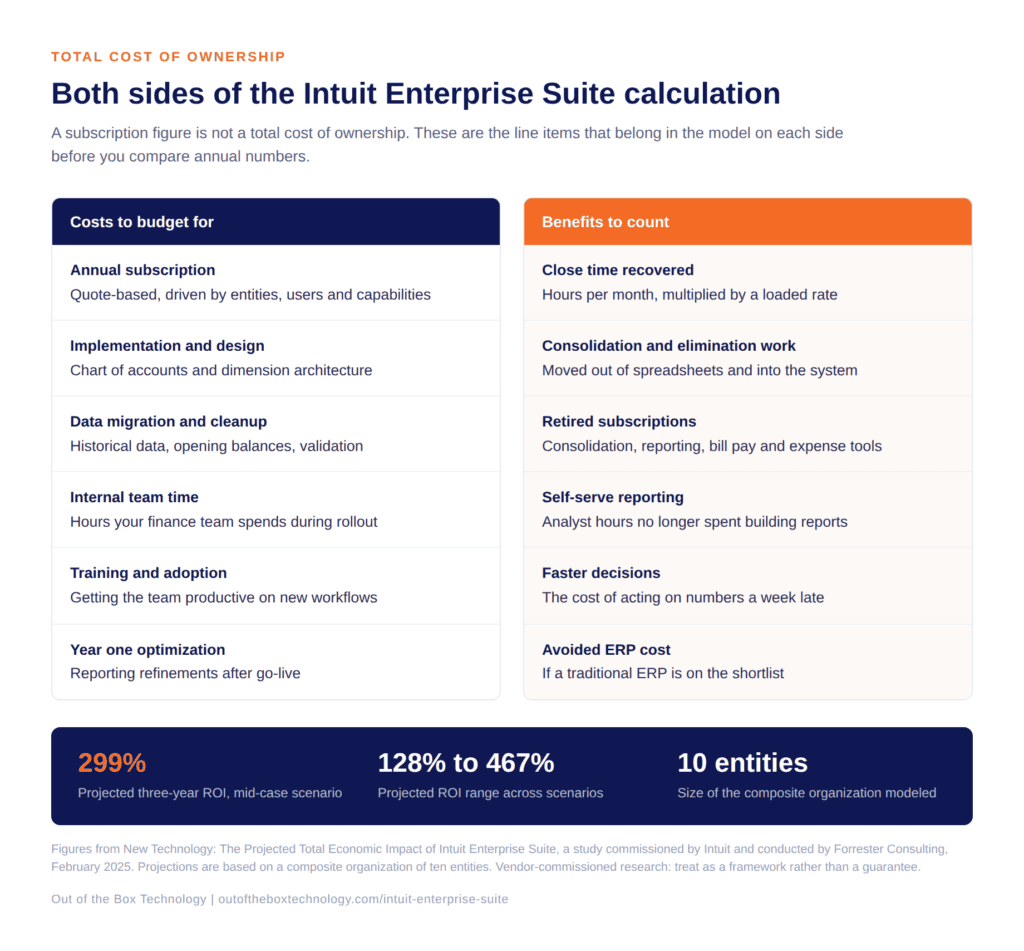 On the cost side, budget for implementation and system design, data migration and cleanup, and internal team time during the rollout. Add training and whatever ongoing optimization you expect in year one. Design work is the line item most often underestimated. Your chart of accounts and dimension architecture determine whether the reporting still works in five years, or whether it needs rebuilding in eighteen months.